Summer in Japan is hot, humid — and somehow, it is also the season for eating one of Japan’s richest foods: unagi, or freshwater eel.
Every summer, Japanese calendars mark Doyo no Ushi no Hi, traditionally known as the day to eat unagi.
In 2026, there was only one summer Doyo no Ushi no Hi: July 26. Some years have two, but this year we had just one.
There was, however, some good news for unagi lovers. Eel prices in Japan were more affordable in some markets this year, helped by an abundant catch of young glass eels and lower wholesale prices.
Why Eat Unagi in Summer?
Unagi has long been associated with restoring energy during Japan’s exhausting summer heat.
And nutritionally, there is good reason for its reputation.
Eel is rich in nutrients including vitamins A, B1, B2, D and E, as well as protein and omega-3 fatty acids such as DHA and EPA.
Rich, satisfying and full of flavour, it became a natural symbol of nourishment during the hottest part of the year.
But what should we drink with it?
For Sake Mom, the answer is simple:
Sake — and not necessarily cold sake.
Warm Sake in Summer?
It may sound surprising.
Cold sake on a hot summer evening makes perfect sense. But sake does not have to follow the temperature outside.
With rich foods such as unagi, warm sake can be wonderful even in summer.
Warming sake changes its texture and expression. The aroma opens, the palate becomes rounder, and the rice-derived umami becomes easier to feel.
That makes it particularly comfortable alongside the richness of eel.
Instead of trying to make everything cold because it is summer, think about the temperature of the food and the sake together.
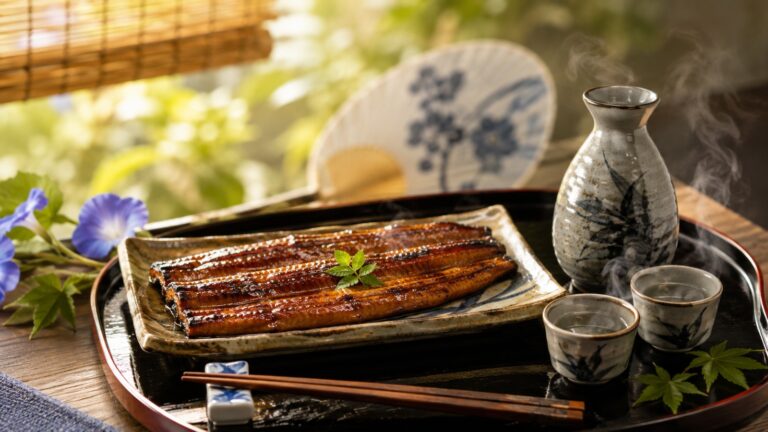
A warm piece of grilled eel and a gently warmed cup of sake can be a very different pleasure from chilled sake — softer, deeper and surprisingly relaxing.
Which Sake Works Best?
For unagi, Sake Mom likes sake with body, umami and enough acidity to stand beside the richness of the fish.
Junmai
Junmai is a natural starting point.
Its rice-driven character and umami work beautifully with grilled eel, particularly the savoury, slightly smoky flavours created over the grill.
Try it at room temperature first, then gently warm it.
The same sake can show a completely different personality.
Yamahai Junmai
For something deeper, try Yamahai Junmai.
Yamahai sake often has more pronounced acidity, umami and earthy complexity. Those characteristics can stand up particularly well to the richness of unagi and the sweet-savoury intensity of kabayaki sauce.
A gently warmed Yamahai with grilled eel is a pairing with real depth.
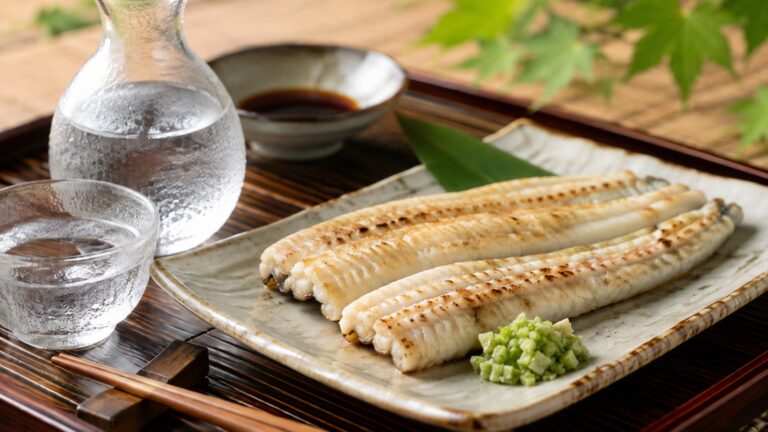
Sake Mom’s Favourite: Shirayaki + Kizami Wasabi
Kabayaki — unagi grilled with its glossy sweet soy-based sauce — may be the most famous style.
But Sake Mom has another favourite.
Shirayaki.
The eel is grilled without the heavy tare sauce, allowing the delicate flavour of the fish itself to remain at the centre.
Add a little kizami wasabi — freshly chopped wasabi.
The richness of the eel, the clean heat and freshness of wasabi, and the gentle umami of warm Junmai or Yamahai create a beautifully simple combination.
No heavy sauce is needed.
Just:
Shirayaki.
Kizami wasabi.
Warm sake.
Sometimes the simplest pairing tells you the most about sake.
Summer does not always have to mean chilled.
Kanpai.